The main difference is that a chatbot talks to your customers, while a custom AI agent can talk to them and take action on their behalf.
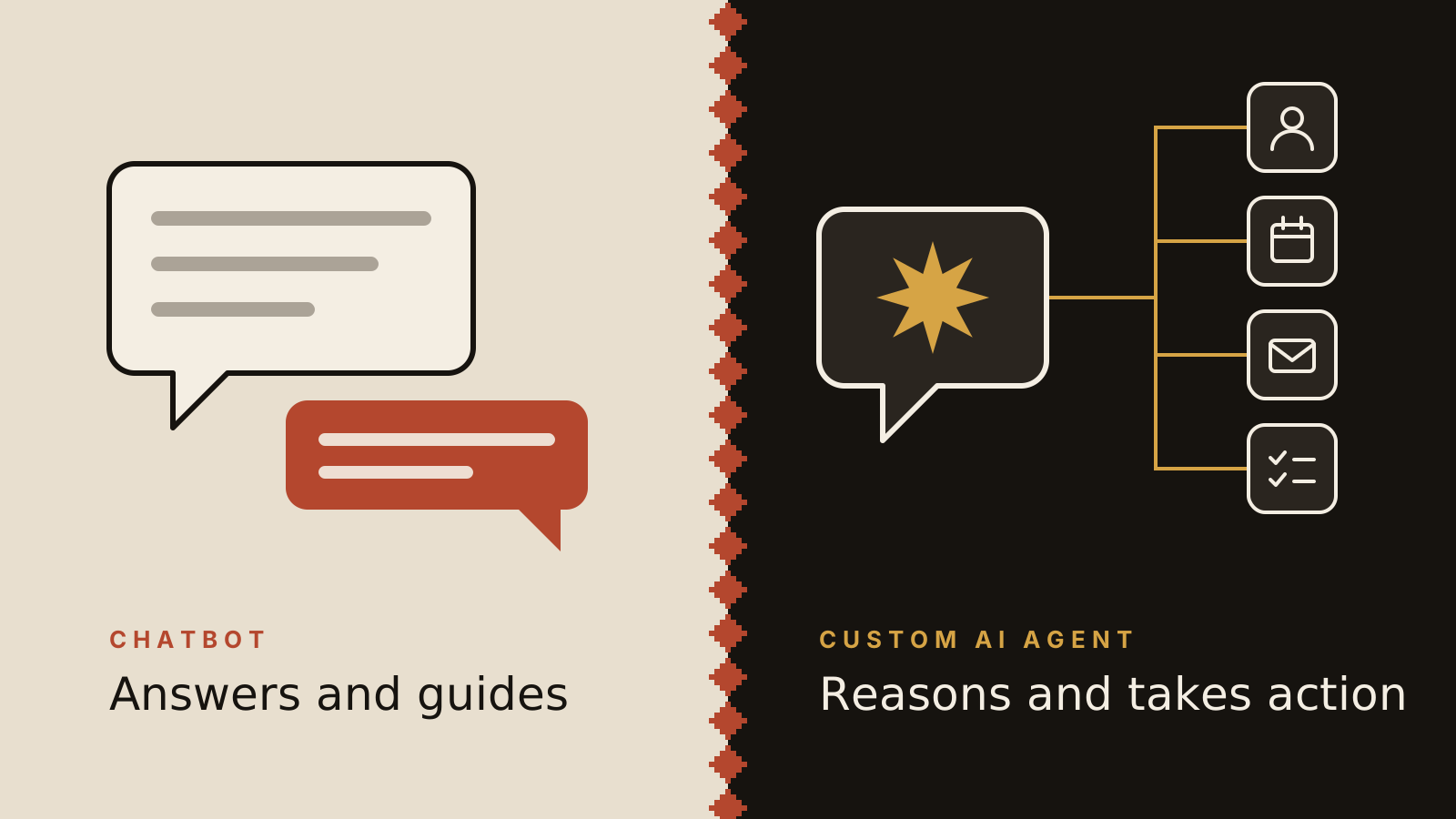
Both can help a business save time, improve customer service, and handle repetitive tasks. They differ in how much responsibility you give the AI and how deeply it connects to your business systems.
Chatbot and custom AI agent
A chatbot answers and guides
A chatbot responds to questions using predefined rules, a knowledge base, or an AI language model. For example, it:
- Answers common questions about products and services.
- Explains business hours, pricing and policies.
- Helps visitors find the right service.
- Collects contact information and qualifies leads.
A custom AI agent reasons and takes action
An AI agent can interpret a goal, decide which steps are needed, use the tools it is connected to, and carry out approved tasks within defined permissions. For example, it:
- Checks a CRM and updates customer records.
- Schedules appointments in a calendar.
- Prepares quotes based on business rules.
- Follows up with leads by email.
- Routes support cases and tracks them to resolution.
Modern chatbots can also use AI and connect to tools, so the distinction is not whether the system uses AI. It is how autonomously the system can work, what tools it can access, and what actions it can perform.
How they compare for a business
| Capability | Chatbot | Custom AI agent |
|---|---|---|
| Answers customer questions | Yes | Yes |
| Uses your business knowledge | Yes | Yes |
| Understands context | Basic to advanced | Often designed for multi-step context |
| Connects to a CRM or other software | Sometimes | Commonly |
| Performs multi-step tasks | Limited or predefined | Yes, within its capabilities |
| Works toward a goal independently | Usually limited | Can do so |
| Setup and maintenance | Usually simpler | Usually more involved |
| Risk if something goes wrong | Generally lower | Can be higher, because it takes actions |
The capabilities overlap. An advanced chatbot may perform transactions, and an agent may use a chatbot interface. What separates them is the level of autonomy and how much of a workflow they carry out.
A real-world example
Imagine you run a home services company, and a customer writes: "I need someone to repair my air conditioner."
With a chatbot. The chatbot explains your services, asks about the problem, collects the customer's contact details, and offers a way to request an appointment.
With a custom AI agent. The agent gathers the relevant details, checks service availability, schedules an appointment, creates a CRM record, sends a confirmation, and notifies the right team, all subject to your rules and permissions.
The chatbot helps the customer figure out what to do. The agent can carry the process through to completion.
Which one should your business choose?
Choose a chatbot if you want to:
- Answer repetitive questions at any hour.
- Capture leads on your website.
- Reduce the volume of basic support inquiries.
- Help customers navigate your products or services.
A chatbot is the better fit when your main problem is communication and access to information.
Choose a custom AI agent if you want to:
- Automate repetitive administrative work.
- Connect your CRM, email, calendar and internal systems.
- Follow up on leads automatically.
- Handle tasks that require several steps or decisions.
- Reduce manual work across business operations.
An agent is the better fit when your main problem is the time your team spends getting work done.
Agents need carefully defined permissions, testing, monitoring, and human approval for sensitive actions such as refunds, payments or binding commitments. More autonomy is not automatically better.
The strongest option may be both
For many businesses, the best design is a customer-facing chatbot powered by a custom AI agent:
- The customer writes in through your website, WhatsApp or another messaging channel.
- The chatbot understands the question and gathers information.
- The agent reasons, follows your business rules and coordinates the tasks.
- Your systems do the rest: CRM and customer records, appointments and follow-ups, email and notifications, tasks and workflows.
This lets customers have a natural conversation while the business automates the work behind the scenes.
Make this specific to your business
The right choice depends on what kind of business you run, what you would most like AI to do, and which systems you already use. Tell us those three things and we will recommend where to start.
AI agentsChatbots
← All posts