For a small business, the best AI consulting firm is not necessarily the one with the most sophisticated AI. It is the one that can identify where AI will make or save money, implement it safely, and leave your team capable of using it.
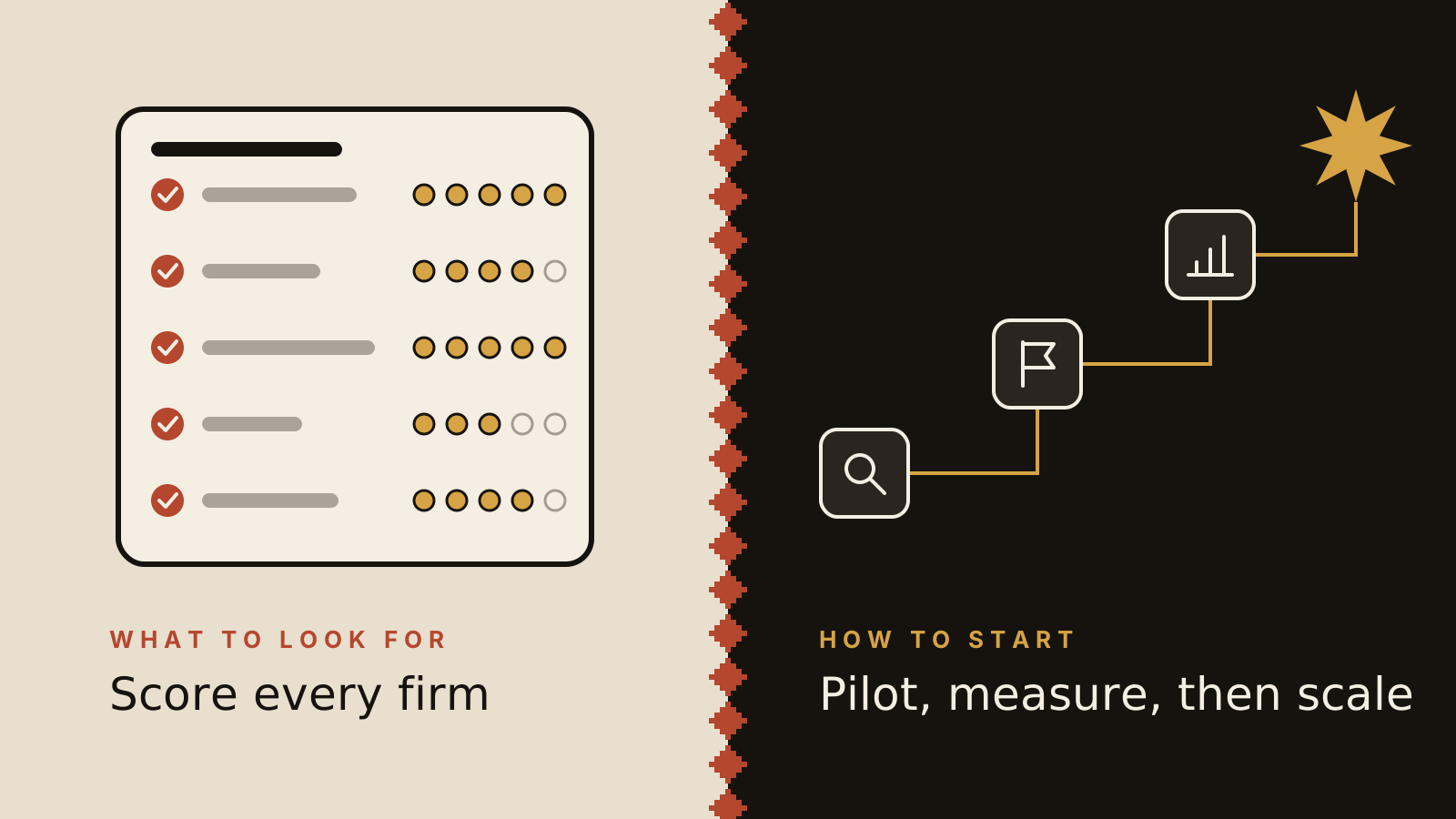
Here is what to look for.
Ten things to look for
1. A business-first approach
The consultant should start with questions like these:
- Where are you losing time or money?
- What repetitive work frustrates your employees?
- Where are customers waiting too long?
- Which decisions require a lot of manual analysis?
- What information is trapped in emails, PDFs, spreadsheets or other systems?
They should also be willing to tell you "AI isn't the right solution here." The AI Risk Management Framework from the U.S. National Institute of Standards and Technology (NIST) recommends evaluating whether AI is appropriate for a particular task, and not assuming that it is.
2. A clear return on investment
Be wary of vague promises like "AI will transform your business."
A good firm defines measurable outcomes before implementation. For example:
- "Reduce proposal-writing time from 4 hours to 45 minutes."
- "Automate 60% of incoming customer inquiries and save 20 staff-hours per week."
The return on AI can be hard to quantify, which is the reason to agree on the measure before the work starts.
3. Experience with businesses your size
Ask:
- Have you worked with companies of fewer than 50 or 100 employees?
- Can you provide relevant case studies?
- What did the client spend?
- What measurable result did they get?
- How long did implementation take?
You do not necessarily need a giant consulting firm. A smaller specialist that understands your industry and budget may suit you much better.
4. Implementation, not only strategy
Avoid firms that hand you a 50-page AI strategy and then disappear. Ideally the firm can take you through the whole path:
- Discover
- Prioritize
- Pilot
- Implement
- Train
- Measure
- Improve
Starting with a small pilot is often sensible. NIST's guidance for manufacturers similarly recommends piloting AI on a limited scope and expanding step by step, and not trying to transform everything at once.
5. Data and integration expertise
An impressive chatbot is not much use if it does not work with the systems you already have. Ask whether the firm can integrate with:
- Microsoft 365 or Google Workspace
- Your CRM
- Accounting software and ERP
- Your website
- Your customer-support platform
- Databases and internal documents
They should also assess whether your existing data is good enough to support what they propose.
6. Security and privacy
This matters a great deal for a small business, because you may be handing an AI system sensitive customer, employee, financial or proprietary information. Ask specifically:
- Where does our data go?
- Is our data used to train a model?
- Who can access it, and how are permissions controlled?
- How is it stored?
- Which third-party AI services are involved?
- What happens to our data if we end the contract?
NIST's AI Risk Management Framework emphasizes documenting third-party AI components, managing organizational risk, and establishing appropriate testing and oversight.
7. Human oversight
A good consultant does not simply say "let the AI handle it." For important workflows, you should know who checks what:
- The AI generates.
- A person reviews.
- The business approves.
- The system acts.
How much oversight is appropriate depends on the consequences of an error. NIST recommends measuring how the system performs and documenting human oversight, errors, overrides and feedback.
8. Training and change management
The technology is only half the project. Ask what happens after implementation:
- Who trains our employees?
- Do you provide documentation?
- Who handles questions?
- How do employees learn when to trust the AI and when not to?
- Will you monitor whether people are using it?
- What happens when the AI or the underlying software changes?
A consultant who builds something nobody uses has not delivered much value.
9. Transparent pricing and ownership
Get very clear about each of these costs:
- Consulting and implementation fees
- AI and software subscriptions
- API or model usage
- Maintenance and support
- Future modifications
- Cancellation terms
Also ask: "What do we own when the project is finished?" Ideally you are not permanently dependent on the consultant to keep your workflow running.
10. A willingness to start small
Be particularly suspicious of anyone proposing a six-figure AI transformation before they have demonstrated value. A better conversation sounds like this:
"Let's identify your three highest-value opportunities, pick the easiest one with a meaningful return, run a pilot for 30 to 60 days, measure the result, and then decide whether to scale."
A simple scorecard
When you interview firms, score each one out of 5 on every criterion and weight the scores like this:
| Criterion | Weight |
|---|---|
| Understands your business | 20% |
| Demonstrated ROI and case studies | 20% |
| Implementation and integration ability | 15% |
| Security and privacy | 15% |
| Industry and small-business experience | 10% |
| Training and support | 10% |
| Transparent pricing | 5% |
| Doesn't oversell AI | 5% |
The last one is surprisingly important. If a consultant tells you that every business problem can be solved with an AI agent, that is a red flag.
Five questions to ask before hiring anyone
- "If you were running my business, where would you use AI, and where wouldn't you?"
- "What measurable financial result should I expect from the first project?"
- "Can you show me a comparable client and the results they achieved?"
- "Exactly what happens to my company's data?"
- "Can we start with a small pilot before committing to a larger engagement?"
If a firm gives you specific, financially grounded answers to those five questions, you are probably talking to the right kind of consultant.
You are welcome to put the same five questions to us. Get in touch and we will answer them for your business.
AI consultingAI transformation
← All posts